



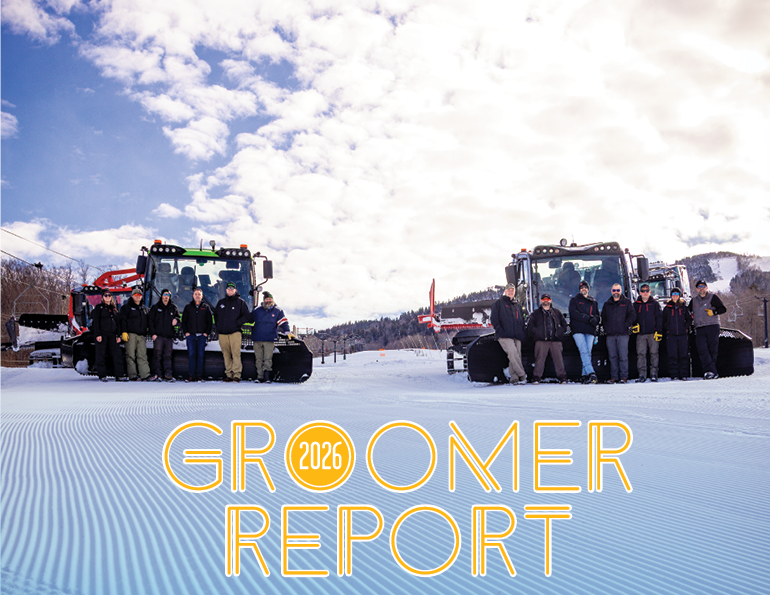
Within the steel and aluminum construction of grooming machines lives digital intelligence that continues to be updated. Modern grooming machine performance is now more controlled via drive-by-wire technology, which allows for greater efficiency and power to be attained automatically with the software responding to working conditions as well as operator input; periodic software updates further enhance functionality. On the more visible end of the spectrum, both manufacturers are also introducing some physical improvements to their newest snowcats.
Amidst the changes, several principles remain paramount for PistenBully and Prinoth: Sustainability, ease of operation, and after-sale support.
An unwelcome change for both companies has been the Trump administration’s haphazard implementation of tariffs on United States trade partners since April 2025. While it has not significantly interrupted shipping, it has complicated the suppliers’ ability to consistently plan, strategize, and price predictably since the levies have changed several times.
Tangled Tariffs
The tariff situation made for a challenging year. PistenBullys are manufactured in Germany and most Prinoths are made in Italy with some manufactured in Canada. The first round of “retaliatory tariffs” in April coincided with the timing of when both companies start to receive their products that are manufactured in Europe. As actual tariff rates, or threats of potential new levies, have unpredictably fluctuated, planning has been a start-stop proposition.
“We’ve spent tons of time working on how to mitigate these challenges,” says PistenBully/SnowSat vice president Jeb Ellermeyer. “But maybe the most important thing is the lack of stability. In business, we can plan for anything. But when the target moves, it’s really difficult because we’d come up with a plan and the situation would change overnight.”
Prinoth product and sales manager Walter Piekarz echoes that. “Quite frankly, it’s been a bit of a nightmare, trying to work against this moving target and trying to plan accordingly,” he says.
It’s complicated. The manufacturers have had to analyze every part of the machine to determine metal type, content, purpose, and country of origin for each part, since tariff rates vary depending on all these factors.
Since April, they’ve had to deal with rates ranging from a blanket 10 percent on imports from the EU to 15 percent as of mid-February, and EU steel and aluminum imports have gone from 25 percent to 50 percent, also as of mid-February, on top of the blanket rate, among other fees.
Both companies are working on ways to be more efficient and reduce costs. Prinoth U.S. snow grooming CEO Andrew Nicolas says they’re exploring all options and working with third-parties to reduce impacts. “Whatever it might be, we’re constantly analyzing it.”
Who pays what? Ultimately, all or a portion of the costs of tariffs got passed on to the customer, which the manufacturers have been transparent about.
“We’re not making any margin on the tariff,” says Nicolas. “We communicate our price for the cat. And then say, for example, if it came in the country tomorrow, this is what you’d pay in tariffs. Of course, whatever the tariff is at the time the machine gets imported is what we pass on. I think that’s the open and honest way to do it.”
Ellermeyer says PistenBully did the same this past year, but if tariff rates remain steady the company “will likely add the import fees (tariffs) into the overall cost of the goods sold,” with PistenBully absorbing a portion of the tariff costs to offer an inclusive price.
Both manufacturers note that the price of steel has risen dramatically as a result of the global trade war. It’s unclear how the Supreme Court’s February ruling that deemed Trump’s tariffs unlawful will affect rates moving forward.
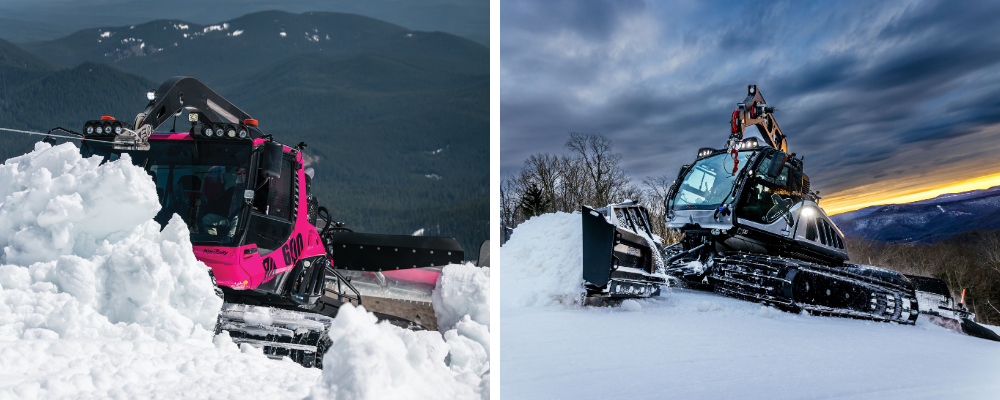 Left to right: The PistenBully 600 ParkPro Winch—shown here with a unique pink paint job—in its natural environment pushing snow (Credit Mike Williams); The Prinoth Bison X Winch includes a wider blade and other park-building features.
The Machines
Now, let’s get to the good stuff.
PistenBully
Uniformity across the operator platforms of the PB 100, PB 400, and PB 600 was achieved in 2022, which allows operators to jump from any of the three and find familiar controls. All three are also now offered in the ParkPro package that includes park-building features such as greater range of motion for the front and rear implements.
Ellermeyer says the 435-horsepower PB 400 is still the company’s “core product in terms of numbers,” but the bigger PB 600 is catching up, especially the 600 ParkPro for ski areas that already preferred 600s and can now get it with the added features that come in that trim.
Green machines. Last year introduced the all-electric PB 100 E, which has seen some improvements to the battery efficiency via software. “So even with the same battery, if you buy a 100 E this year, next year’s software release could make your batteries more efficient,” says Ellermeyer. Bigger improvements to the actual battery hardware—such as making it lighter and longer lasting—are down the road. In the meantime, software updates will have a big impact.
The diesel-electric PB 600E+, which combines the power of a 600 with lower emissions and greater fuel efficiency, has also had some software updates to improve efficiency and a slightly different final drive system.
Prinoth
Piekarz says the Bison remains Prinoth’s most popular snowcat in North America—it’s a size operators are used to—and the larger, more powerful Leitwolf is the most popular in Europe. But the Leitwolf is catching on over here thanks to its size and performance, he says, pointing to the adjustable suspension and parallel offset tiller as features that, if utilized correctly, “can put down a hell of a ski surface very efficiently.”
All three snowcats in the fleet, including the smaller Husky, come in the optional X trim, which comes with a premium sound system, a wider blade with greater geometry, and other features for park-building that are also useful for trail grooming.
Green machines. The battery-powered Husky E-Motion has been on the market in North America for a couple years, and interest is growing. Nicolas says there have been several successful demos this year.
Prinoth is also still working on the hydrogen-powered H2-Motion. Despite full-scale production still awaiting more robust hydrogen storage and distribution infrastructure to make it a tenable product, the company has taken various learnings from developing the H2-Motion and applied them to its diesel-powered snowcats.
“Sustainability is always important,” says Nicolas. Despite federal regulatory rollbacks on emissions standards, when it comes to developing more eco-friendly snowcats, he says, “We’re not going to take our foot off the gas.”
What's New
PistenBully
After several years of development, the new SmartCut tiller is being introduced and will replace the AlpenFlex as the standard tiller for PistenBully machines starting with model year 2026. Ellermeyer says the SmartCut is based on the AlpenFlex design with a few key enhancements, including a new cutter bar profile with teeth that are a different angle, length, and shape; enhanced comb profile; and central greasing.
“The SmartCut went through pretty intensive development and lots of testing that we were a part of here in North America,” says Ellermeyer. “After several iterations, we’ve got a tiller that’s more efficient at cutting and processing snow, and displays the corduroy more consistently in different conditions.”
In addition, the Kässbohrer Fast Exchange (KFX)—a connection system that allows operators to remove and reconnect the tiller in less than 30 seconds without leaving the cab—is in full production for 2026, available for use on the PB 600 platform.
Inside new PistenBullys, a variety of smaller yet meaningful new enhancements made with operator comfort in mind are being introduced, including a new operator seat with improved padding, lateral support, and a tackier surface to minimize sliding while driving at an angle; concaved, convex, and braille joystick buttons that improve tactile differentiation; and the new SnowSat monitor, which has better resolution, is usable in wet conditions, and has multi-touch features such as pinch-to-zoom. A built-in backpack holder in the cab and additional tool storage on the outside of the machine have also been added.
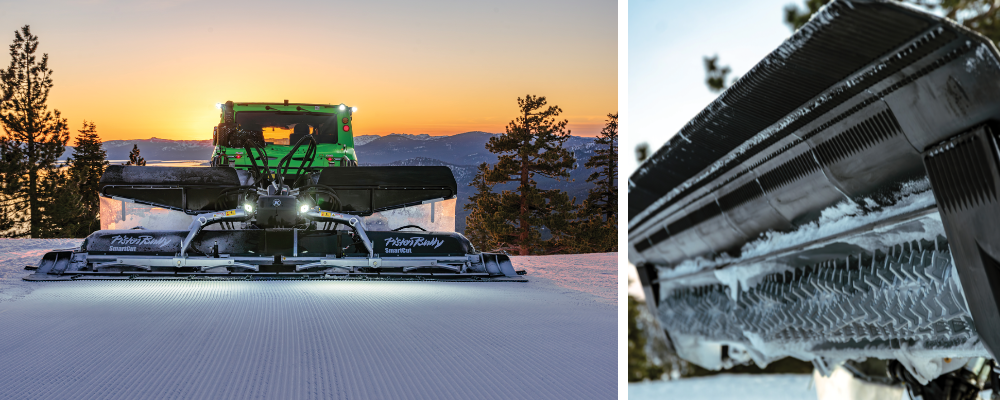 Left to right: The SmartCut on a PistenBully 600E+; Right: The new PistenBully SmartCut tiller features an entirely new cutter bar, comb profile, and central greasing. (Credit Nick McMahon)
Prinoth
Prinoth’s closed profile steel tracks now feature increased tensile belt strength to increase service life, and the shape of the top curvature of both the closed profile and aluminum Gamskette G tracks has been updated to improve grip in hardpack conditions.
On the front of the snowcat, Bison X machines now come standard with the X Blade. “The blade was designed to make more precise cuts, which reduces handwork and saves time,” says Piekarz.
New Master Husky Blades for models 2.8 and 3.1 are modeled after the Master Blade of the Bison and Leitwolf. The blade’s shape encourages the snow to roll inside the blade, eliminating spillover.
Prinoth is also introducing a transport cabin for the Bison (model BO) and Leitwolf (models LT, LI, and LE) that can carry up to 15 passengers, six more than the Husky transport cabin, previously the only snowcat in the fleet with an available transport cabin option.
A new backup camera features an intelligent algorithm that quickly adjusts the image in changing light conditions. The integrated high-performance imager with a low-light sensitivity of 1 millilux provides a good view even when it’s very dark outside. The camera also has an anti-ice and anti-fog function. Also getting an upgrade is the camera on the back of the winch, which now has a wider, 150-degree view behind the winch.
Inside the cat, Prinoth removed the lights on the joystick based on operator feedback, and improved the mobile-phone holder.
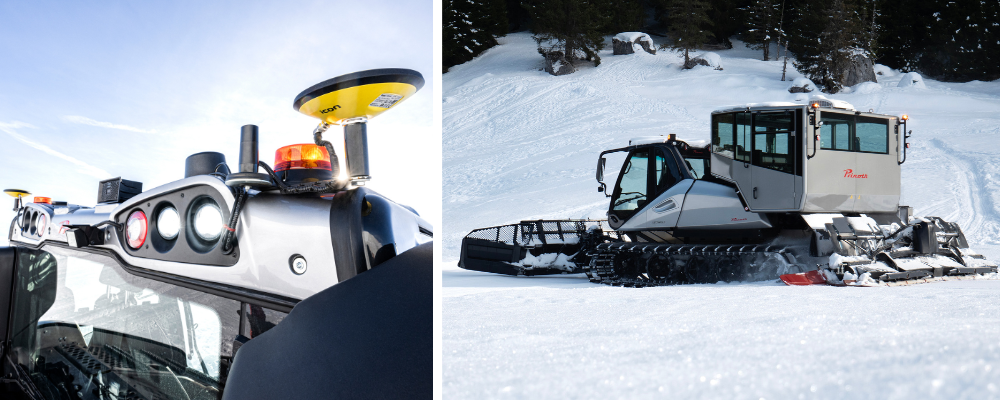 Left to right: The new low-light sensitive backup camera and Prinoth Connect Snow Measurement hardware on the cab of a cat; Prinoth has introduced a new 15-passenger transport cabin for the Leitwolf and Bison.
Support and Training
PistenBully
PistenBully’s network of regional fulfillment centers includes five branches covering different regions of the country and five independent dealer fulfillment centers, too. The Reno, Nev., headquarters is also home to the Sierra regional hub, which expanded its parts storage with a new multi-level mezzanine.
Inventory. Ellermeyer says that aligning the mechanical and operational platforms of the PistenBully fleet reduces the number of different parts needed for inventory. “The changes we’ve made to our snowcats directly impacts the after sale, because there’s continuity for the mechanics,” he says.
Of course, the company keeps parts for older snowcats on-hand since ski areas have mixed-gen fleets, and that depends on the region—Colorado ski areas, for example, tend to have newer snowcats while Midwest ski areas hang on to their cats a little longer, so the parts inventory reflects that.
Winch Camp. PistenBully put on its inaugural “Winch Camp” last spring near Reno, conducted through PistenBully Pro Academy, the training arm of the company that also includes online courses for operators and mechanics. The all-day, sold-out operator training event included a classroom session, a maintenance session, and an on-hill session. “So they got the full picture of theory, how to maintain your machine, and how to run it,” says marketing manager Liz Worgan, who was part of a group that spearheaded the program.
PistenBully is holding another Winch Camp at Sunday River, Maine, in March.
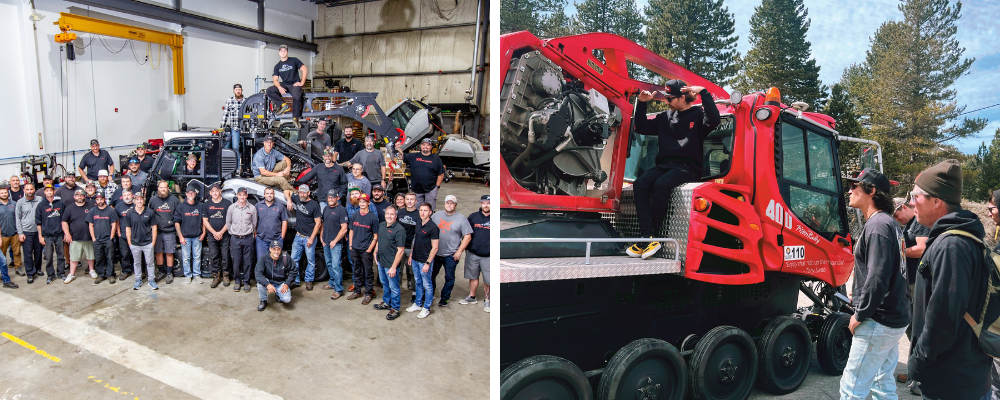 Left to right: The Prinoth service team has grown in recent years as the company broadens its coverage and capabilities to serve existing customers; PistenBully held its inaugural “Winch Camp” last spring, a training day with classroom and maintenance sessions, and on-hill instruction.
Prinoth
Prinoth recently conducted a detailed parts pricing analysis, “and the result is that customers will see lower pricing and increased parts availability,” says Prinoth director of customer service Jesse Gibson.
Parts savings. Coinciding with the annual spring parts promotion, the average price of parts will be 8 percent less. Some of these savings will be realized by Prinoth locally sourcing parts such as hoses, fasteners, and wear items like filters, bearings, and bushings. “This will help reduce prices due to both parts availability and the impact from tariffs,” says Gibson.
The company has also grown its parts and service staff across the country, adding three more remote technicians last year. And the Grand Junction service shop has expanded with the addition of three more garage bays.
Workforce development. In addition to supporting workforce development through Prinoth Academy online training modules and in-person training offerings, Prinoth has also sponsored the burgeoning workforce growth program, The Pipeline Project, which creates connections between ski areas and high-school career and technical education (CTE) programs, teachers, and students.
“Prinoth is working hand-in-hand with The Pipeline Project to develop curriculum tailored for CTE teachers to bring to their classrooms in an applied learning setting, which will help the students be prepared to step into roles in the ski industry,” says Prinoth marketing manager Rachel Templar.
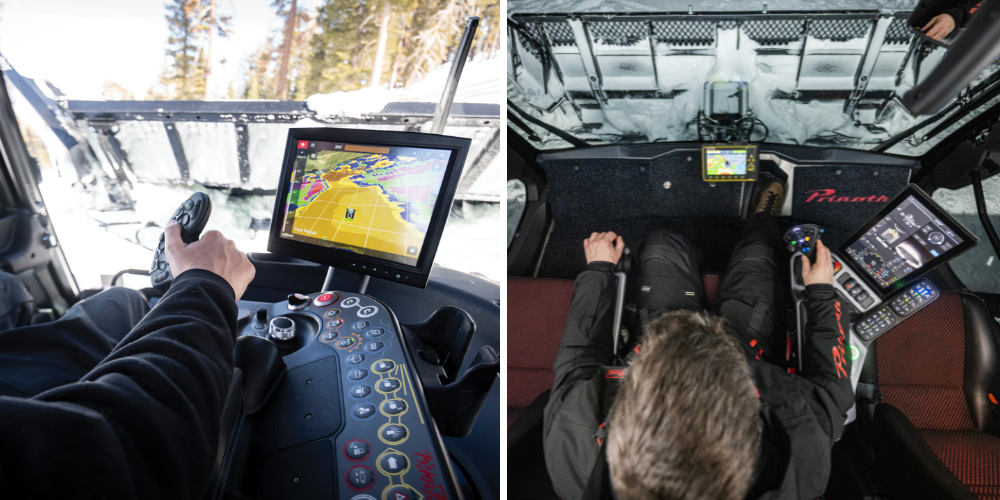 Left to right: The operator platforms of all PistenBully snowcat models are uniform and can include SnowSat snow-depth monitoring technology (Credit Kate Abraham); The cab of a Prinoth Leitwolf with Prinoth Connect Snow Measurement screen at the operator’s feet in view of the blade.
Eyes on Snow Depth
PistenBully SnowSat and Prinoth Connect Snow Measurement systems have become increasingly popular among ski area operators for their usefulness in helping determine where snow is needed—and where it’s not.
SnowSat is focused on improving the user interface to make it more efficient for operators to use. A new screen with more sensitive touch capabilities and display settings is part of that effort.
The Prinoth Connect Snow Measurement screen is mounted by the operator’s feet, right in view of the blade, making it more efficient for the operator to view the snow depth levels ahead of and beneath the machine without having to look away.
Outlook. Both companies are doubling down on innovation and after-sale support to deliver measurable value to their ski area customers.